Your (lower) roadside companion

Heterotheca villosa, June 9, 2025

Common & scientific name

Hairy golden aster, Heterotheca villosa

Family

Sunflower, Asteraceae

Location

Roadside, 8,200’

Fun, weird, helpful, or little known fact

While all guide books describe this plant as “highly variable” (in size, leaf shape, hairiness, etc.), it is easily identifiable by its strongly pungent smell, location (dry, exposed places, often roadside), and its numerous yellow flowers atop a mound of grayish-green leaves.  Its alpine cousin, H. pumila, looks similar (and they may interbreed), but it generally has larger yellow flowers and, well, grows higher.  I tried for years to distinguish these two species, but have now decided not to make the perfect the enemy of the good: if it’s up high, it’s H. pumila, if it’s not, it’s H. villosa.
Alpine delight

Draba lonchocarpa, June 3, 2025

Common & scientific name
Lancepod draba, Draba lonchocarpa

Family
Mustard, Brassicaceae

Location
Above Linkins Lake, 12,400’

Fun, weird, helpful, or little known fact
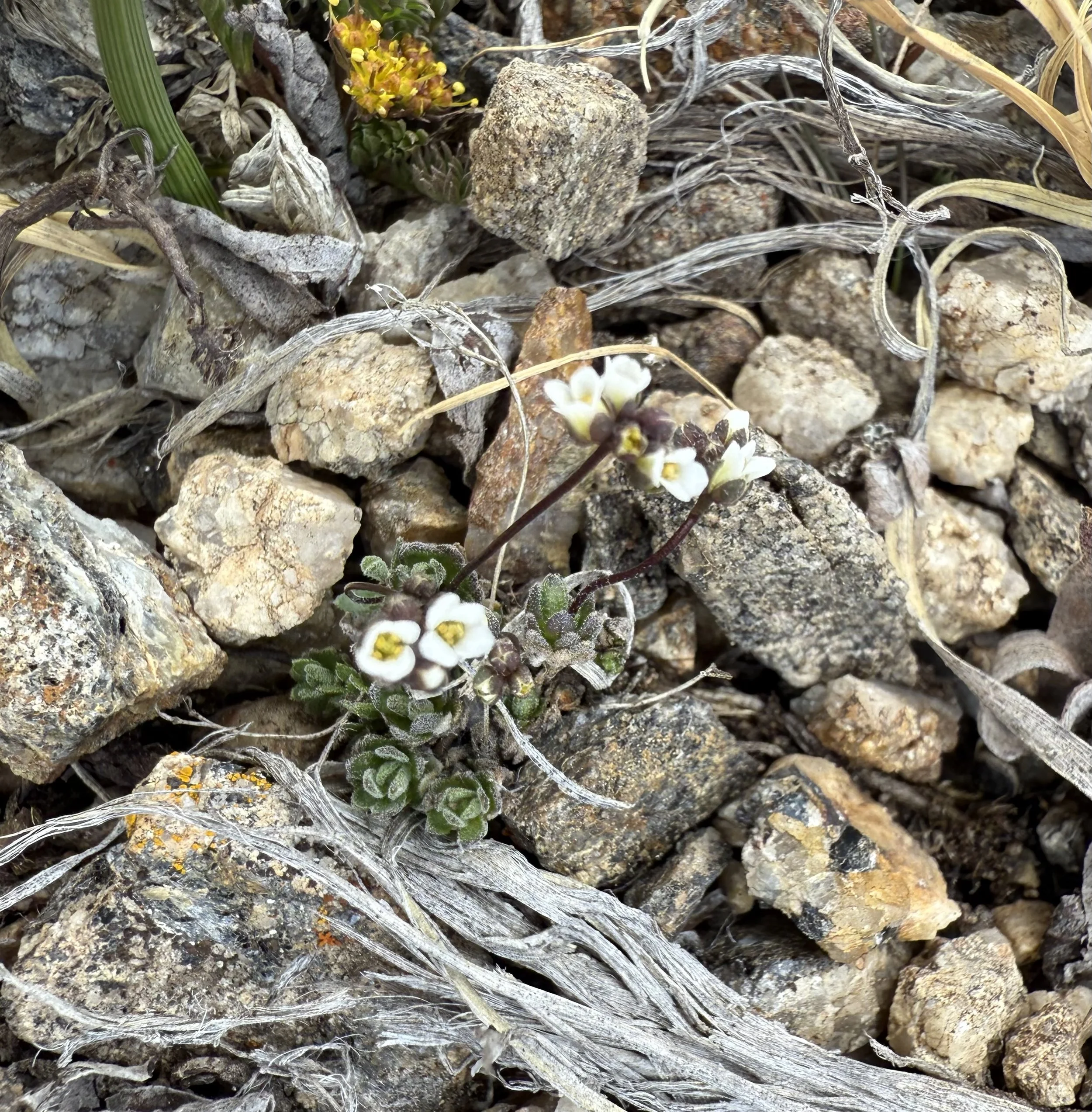
A most delicate alpine draba with white flowers, standing standing an inch or two high, densely pubescent leaves, glabrous, and dark-purple stalks with no leaves. This is as fine a find in the alpine as any!

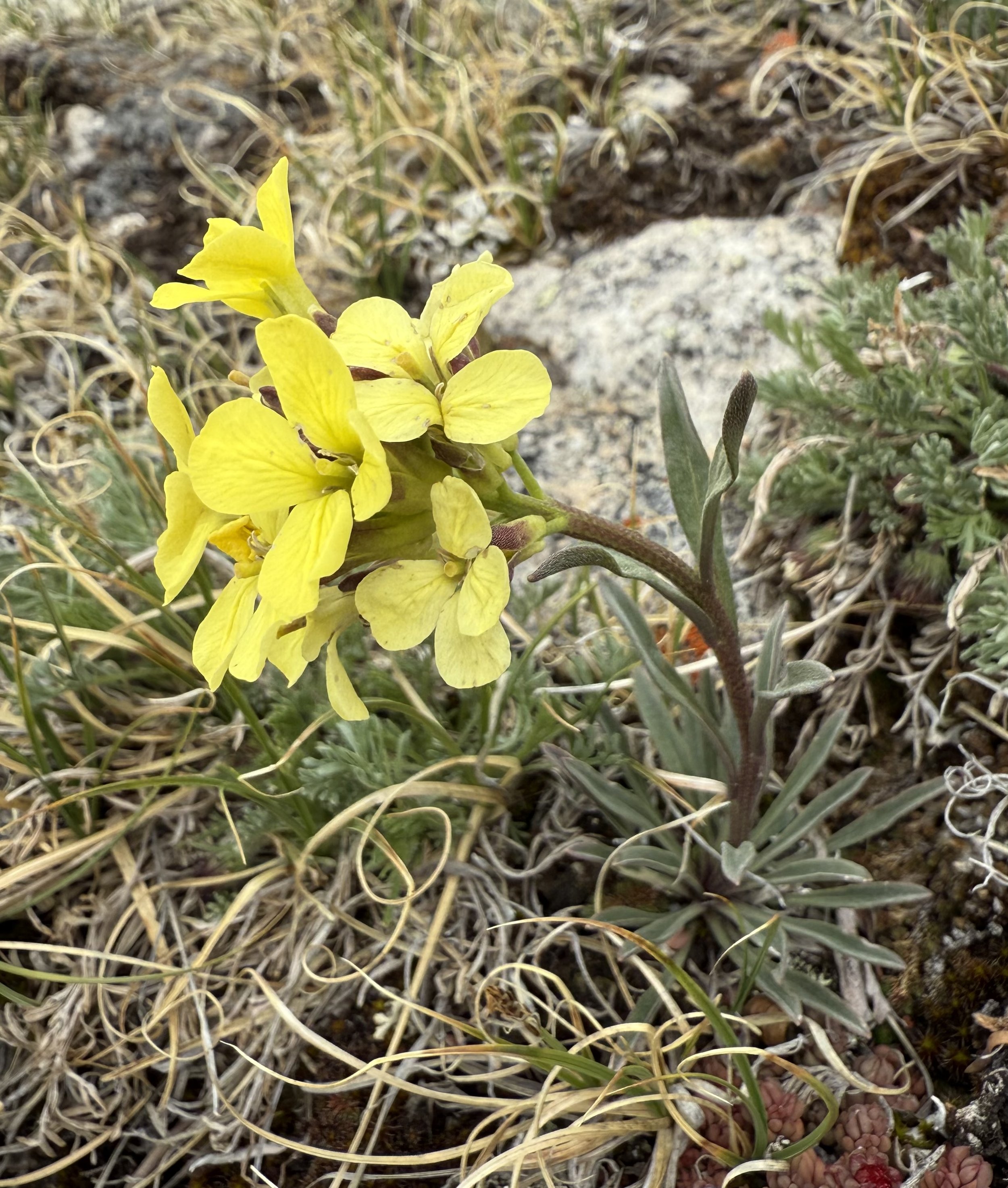
Yellow to the west, lavender to the east

Erysimum capitatum, June 3, 2025

Common & scientific name

Western wallflower, Erysimum capitatum

Family

Mustard, Brassicaceae

Location

Above Linkins Lake, we,300’

Fun, weird, helpful, or little known fact

This big, cheery mustard is as at home on the summit of Independence Pass as it is in the deserts of Utah. It is most commonly yellow, but on the east side of the Pass, especially up near treeline, it is a striking lavender-magenta, as seen here.

No wiping your feet on this mat

Trifolium nanum, June 3, 2025

Common & scientific name

Dwarf clover, Trifolium nanum

Family

Pea, Fabaceae

Location

Summit, 12,100’

Fun, weird, helpful, or little known fact

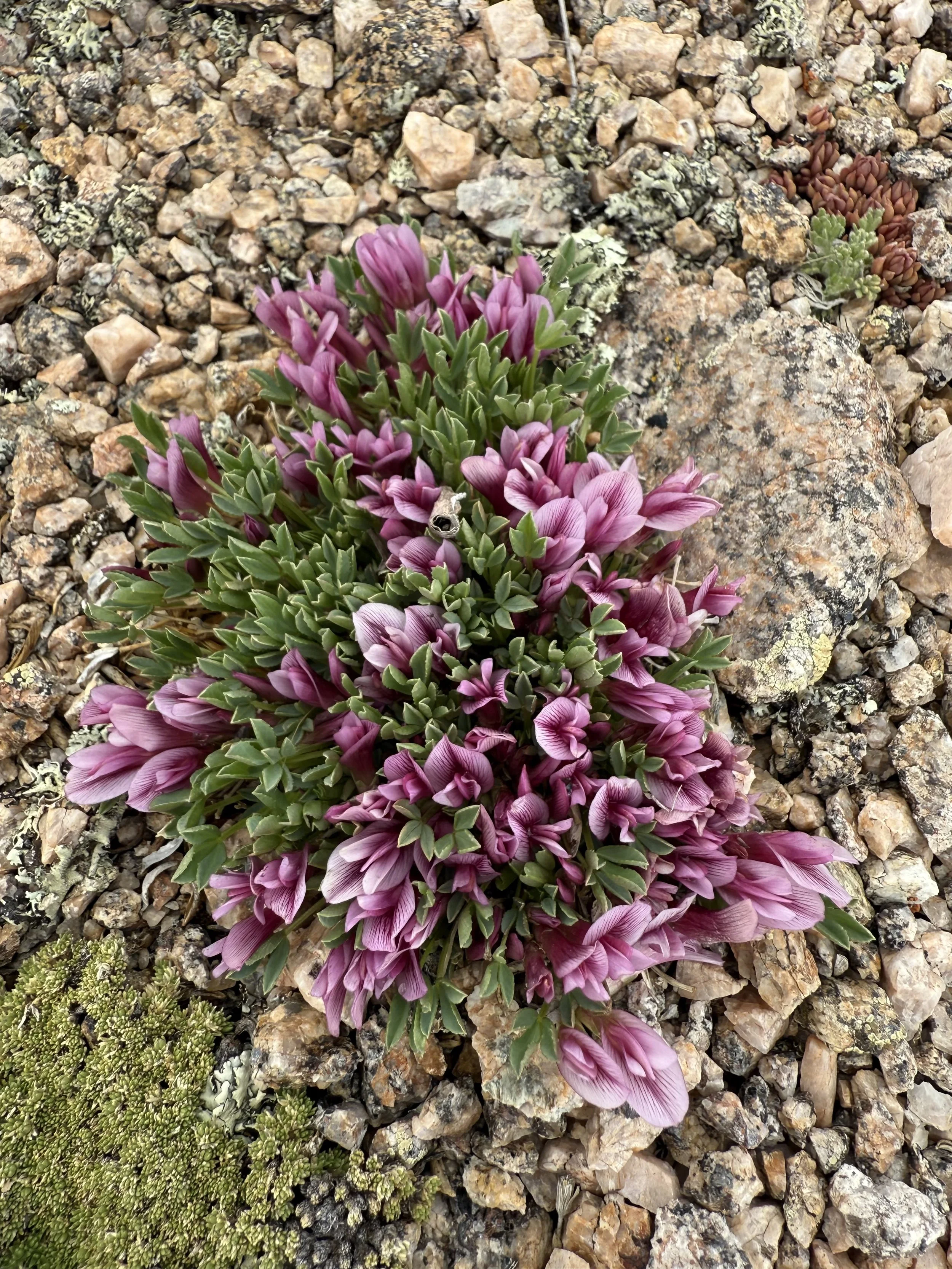
This exclusively alpine pea hugs the ground, coming in at just an inch or so high (“nanum” is Greek for “dwarf.”) It’s hard to miss, though, as it forms densely-packed mats of elegant pin-striped flowers ranging from whiteish-pink, to lavender, magenta, and purple (and very occasionally in whitish-yellow form).

Best name ever?

Smelowskia americana, June 3, 2025

Common & scientific name

Alpine smelowskia, Smelowskia americana

Family

Mustard, Brassicaceae

Location

Summit, 12,100’

Fun, weird, helpful, or little known fact

I love this flower so very, very much. In part because it is one of the first flowers of the season to emerge in the high alpine, so it is always a welcome sight. In part because it can range dramatically in size depending on how protected it is—there is a bouquet on Treasure Mountain tucked into a large marble boulder that is three times the size of the plants, both stems and flowers, seen in these photos. In part because its usually white petals sometimes emerge a lovely soft lavender. But mostly because of its name, in honor of the 18th century Russian botanist T. Smelovskii. This is one botanical name that is a joy to learn and say.

At home in the great white north

Silene acualis, June 3, 2025

Common & scientific name

Moss campion, Silene acaulis

Family

Pink, Caryophyllaceae

Location

Summit, 12,100’

Fun, weird, helpful, or little known fact

This perennial favorite of the high alpine occurs in almost all arctic and alpine habitats throughout the northern hemisphere. It reaches as far south as Arizona and as far north in Greenland well above the arctic circle, within twenty-five miles of the most northern growing of any plant. And according to extensive studies done on this alpine jewel in the 1950s in Rocky Mountain National Park, its roots go down as far as six feet—hard to believe in the (very) Rocky Mountains.

A rose by any other name

Sibbaldia procumbens, June 3, 2025

Common & scientific name

Sibbaldia, Sibbaldia procumbens

Family

Rose, Rosaceae

Location

Linkins Lake Trail, 11,700’

Fun, weird, helpful, or little known fact

At first glance sibbaldia doesn’t look like it belongs in the Rose family: its three-part leaves are clover ( Pea--like), and its tiny, greenish-yellow flowers hardly call to mind our showy Wild rose, Rosa woodsii.

Upon closer inspection, however, one finds they do indeed have 5 petals and 5 sepals (the green, leaf-like parts enclosing and protecting the bud/flower), and their leaves are reminiscent of wild strawberries (in the Rose family). Indeed, upon further consideration, only Rosa woodsii REALLY looks like a rose proper—it’s a wonderfully variable family.

Bedding down for the summer

Paronychia pulvinata, June 3, 2025

Common & scientific name

Alpine nailwort, Paronychia pulvinata

Family

Pink, Caryophyllaceae

Location

Above Linkins Lake, 12,300’

Fun, weird, helpful, or little known fact

Inconspicuous yellow-green flowers embedded in tight, sometimes large mats, often growing directly on the crumbling granite of our high peaks. This low-lying, wonderfully subtle flower knows how to make the best of things amidst the hard, desiccating winds of the high alpine!

Never to be forgotten

Eritrichium nanum, June 3, 2025

Common & scientific name

Alpine forget-me-nots, Eritrichium nanum

Family

Borage, Boraginaceae

Location

Summit, 12,100’

Fun, weird, helpful, or little known fact

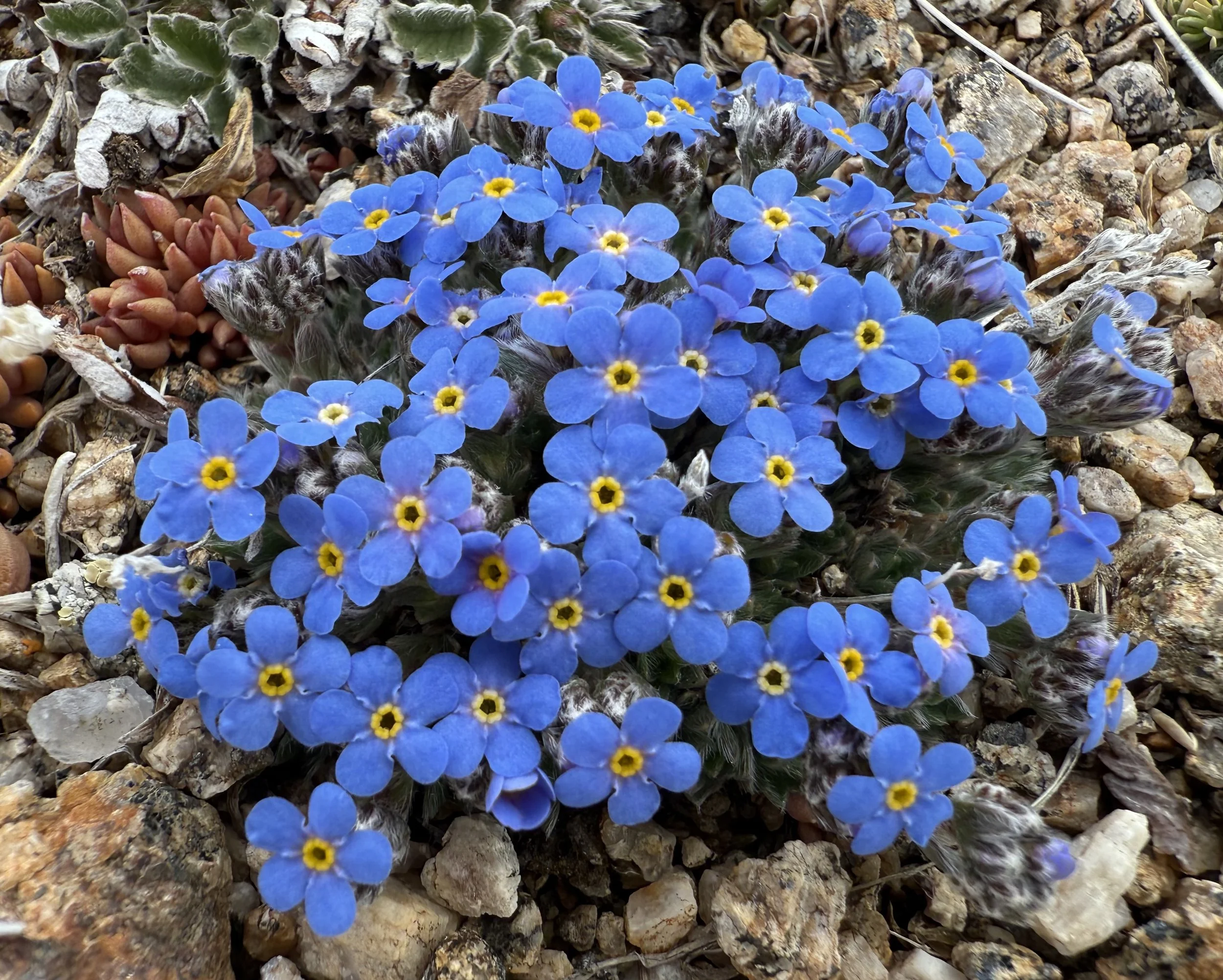
This ground-hugging alpine jewel is many people’s favorite wildflower, period. Its Kodachrome-blue petals and golden eyes are unique in our region, and its favorite habitat—rocky, windswept, highly inhospitable mountain tops and ridges—makes its beauty and sheer existence all the more jaw-dropping. Because this flower blooms early and won’t stick around too long, it is worth dropping everything to get up high and bow down to this wonder of creation.

A daisy to delight in

Erigeron pinnatisectus, June 3, 2025

Common & scientific name

Cutleaf daisy, Erigeron pinnatisectus

Family

Sunflower, Asteraceae

Location

Summit, 12,100’

Fun, weird, helpful, or little known fact

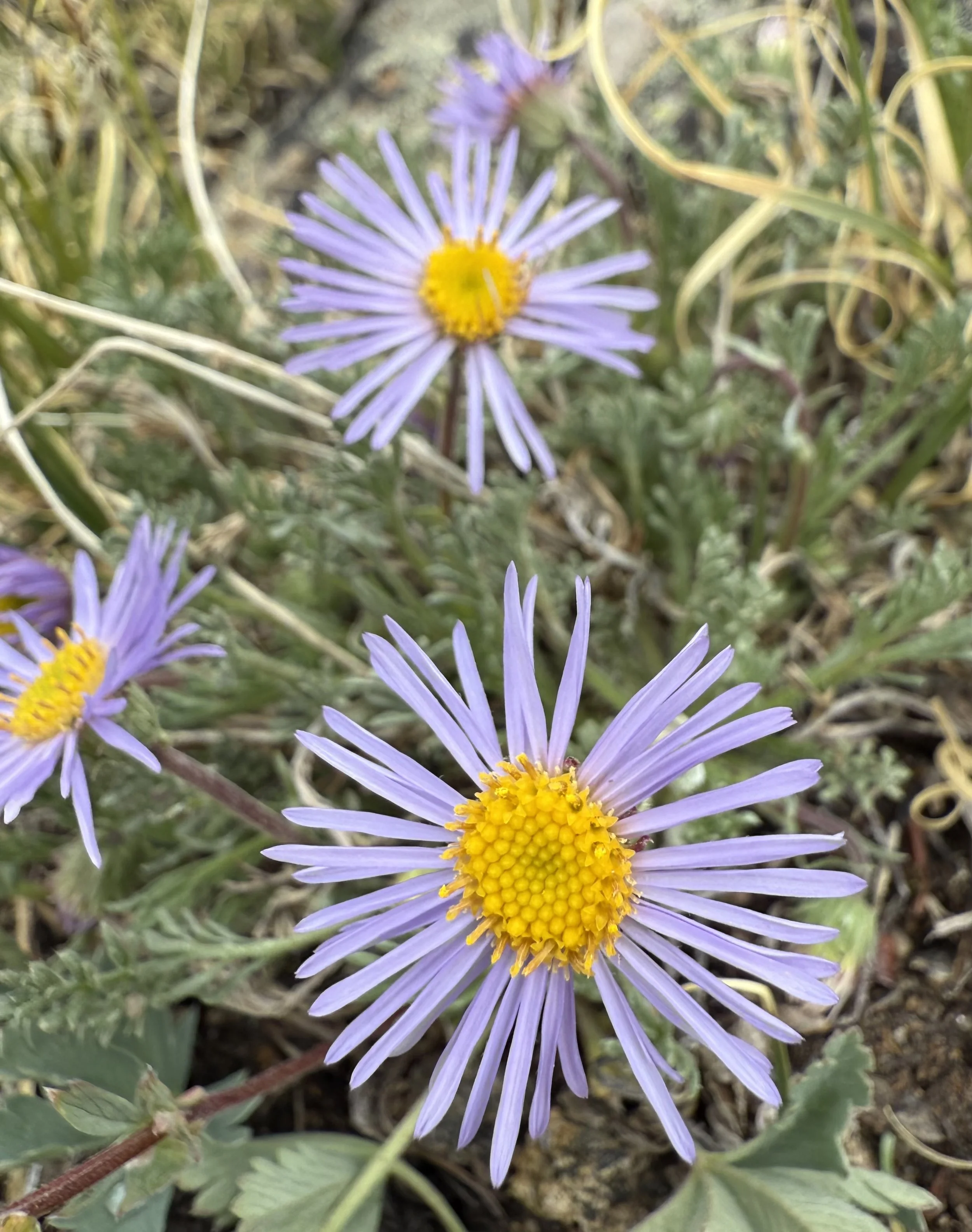
Its finely-cut leaves and large, light-purple heads distinguish Erigeron pinnatisectus from other subalpine and alpine daisies. It is common on our rocky tundra.

The white in red, white & blue

Cherleria obtusiloba, June 3, 2025

Common & scientific name

Alpine sandwort, Cherleria obtusiloba

Family

Pink, Caryophyllacaea

Location

Summit, 12,100’

Fun, weird, helpful, or little known fact

Reminiscent of alpine forget-me-nots and moss campion in its matted structure and (relatively) large flowers compared to its leaves, alpine sandwort thrives, too, on dry, rocky, windy alpine ridges, and is always a treat to encounter.